11 Jun 2026
Deciphering Interplay Between Table Minimums and Promotional Credit Allocation in Multi-State Digital Baccarat Networks
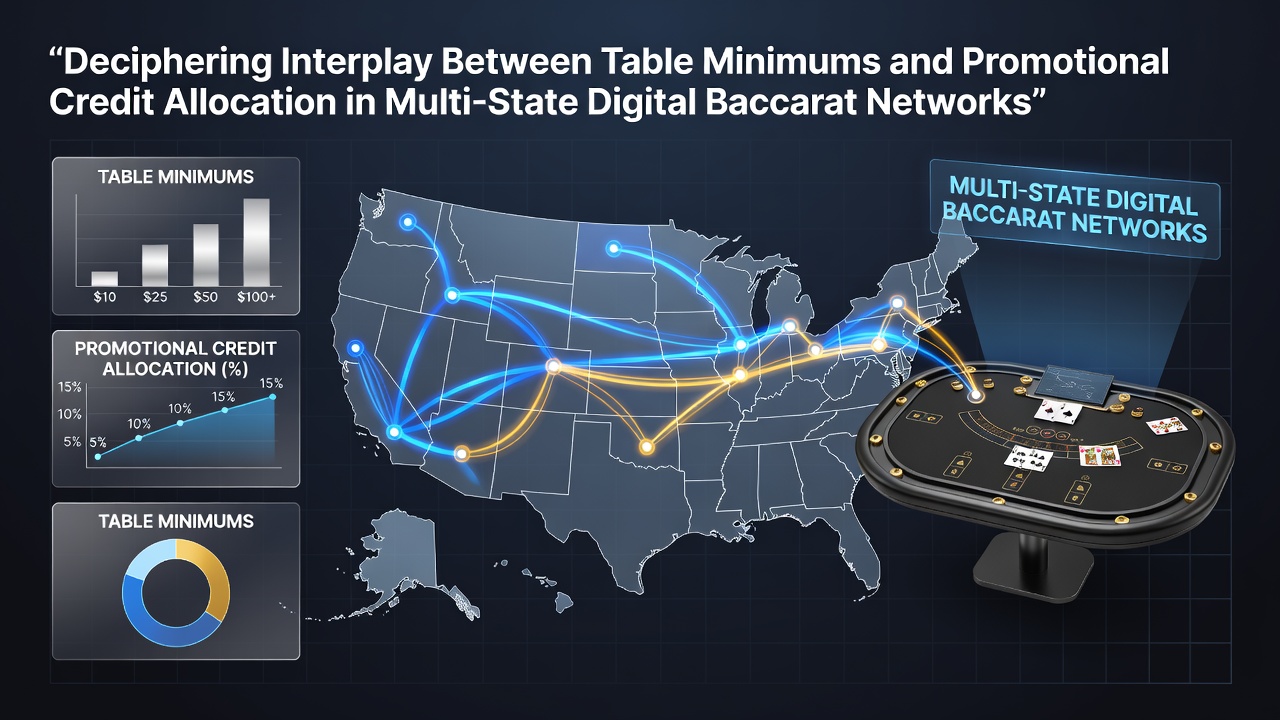
Multi-state digital baccarat networks operate under layered regulatory frameworks where table minimums directly shape how promotional credits get distributed and redeemed, and operators adjust allocation rules to maintain compliance while supporting player activity across jurisdictions like New Jersey, Pennsylvania, and Michigan.
Table Minimum Structures in Cross-Border Platforms
Table minimums in these networks range from $5 to $100 per hand depending on the state licensing requirements and the specific operator's risk parameters, while promotional credits often carry separate minimum thresholds that players must meet before any bonus funds convert into playable balances on baccarat tables. Data from state gaming reports indicate that platforms synchronize these minimums through centralized algorithms that factor in each jurisdiction's house edge tolerances and player volume metrics, which prevents promotional credits from being applied to tables where the minimum exceeds the credit value itself.
Operators monitor these alignments in real time because mismatched minimums can trigger automatic holds on credit releases, and regulatory filings show that such holds occur most frequently during peak evening hours when traffic spikes across multiple state servers simultaneously.
Promotional Credit Allocation Mechanisms
Promotional credits reach players through deposit matches, loyalty rewards, or targeted free-play offers, yet allocation engines must parse state-specific rules before assigning those credits to baccarat sessions, and the process typically involves tagging each credit batch with metadata that includes expiration windows, wagering multipliers, and eligible table tiers. Research from industry analytics groups reveals that credits allocated to lower-minimum tables tend to circulate longer before depletion, whereas higher-minimum tables accelerate credit turnover rates by 30 to 40 percent on average, according to aggregated transaction logs submitted to gaming control boards.
Allocation systems therefore prioritize tables whose minimums align with remaining credit balances to avoid partial redemptions that leave unusable fractions behind.

Regulatory Influences on Minimum-Credit Interactions
State regulators require operators to publish clear mappings between table minimums and promotional eligibility, and filings from the Pennsylvania Gaming Control Board illustrate how platforms revised their credit allocation protocols in early 2026 to accommodate new minimum bands introduced after legislative updates. Similar adjustments appeared in Michigan and New Jersey reports around the same period, where operators introduced dynamic minimum scaling that lowers entry points for promotional credit users while preserving standard minimums for cash players.
These changes emerged because regulators demanded greater transparency around how bonus funds interact with table stakes, and compliance teams responded by embedding minimum verification steps directly into the credit activation sequence.
Technical Integration Across State Networks
Backend systems in multi-state networks use unified player accounts that carry credit balances across borders, but each state's front-end interface enforces its own minimum filters before allowing a hand to proceed with promotional funds, and this creates brief latency windows during which credits appear locked until the system confirms table eligibility. Technical documentation submitted to oversight bodies shows that these filters rely on geolocation pings combined with real-time minimum tables pulled from a shared database, reducing instances of credit misuse while maintaining session continuity for players moving between state servers.
Network operators report that such integration has stabilized since mid-2025, when initial rollout issues caused frequent credit rejections at tables whose minimums exceeded allocated balances.
Player Behavior Patterns Under Minimum Constraints
Transaction data aggregated by gaming associations indicate that players shift toward tables with minimums that closely match their available promotional credits, and this migration concentrates volume on mid-tier tables during promotional periods while leaving higher-minimum tables reliant on cash-funded play. Patterns observed in June 2026 logs reveal that credit redemption rates climb when minimums sit at or below 20 percent of the credit amount, whereas redemptions drop sharply once minimums exceed that ratio, prompting operators to issue supplementary micro-credits for bridging gaps.
These behavioral responses feed back into allocation models that recalibrate future offers based on observed table preferences across the network.
Conclusion
The interplay between table minimums and promotional credit allocation continues to evolve as multi-state digital baccarat networks refine their technical and regulatory alignments, and ongoing filings from bodies such as the New Jersey Division of Gaming Enforcement and reports from the American Gaming Association document incremental adjustments that keep credit flows consistent with each jurisdiction's requirements. Observers note that these refinements support sustained player engagement while satisfying oversight demands for clear, auditable allocation processes.